
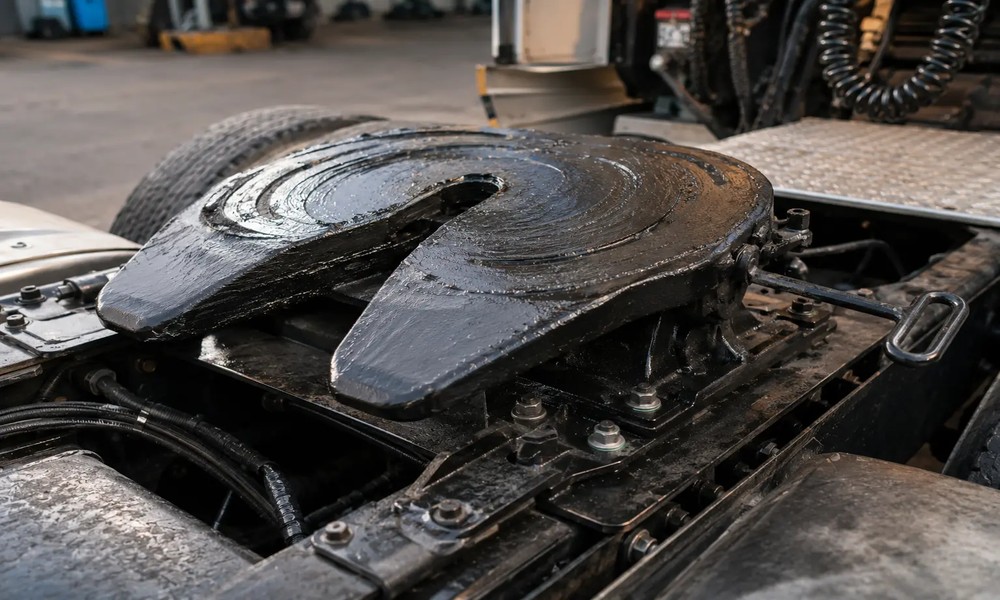
The fifth wheel coupling is the only mechanical connection between a tractor and its trailer. It carries the full vertical load of the front of the trailer, absorbs the shock of acceleration and braking, and pivots through every turn without fail. On a loaded Class 8 combination, that connection may be managing 35,000 to 40,000 pounds of vertical load at highway speed. Despite that responsibility, the fifth wheel is one of the most under-maintained components in commercial trucking – routinely skipped during quick PM turnarounds in favor of more visible service items.
The consequences of neglecting fifth wheel maintenance are not abstract. Trailer separations do occur, and when they do, the investigation almost always reveals the same preventable causes: contaminated and degraded grease in the locking mechanism, excessive wear in the jaw and kingpin contact surfaces, or fastener failures that went undetected because the coupling was never properly inspected. This guide covers what fleet operators, diesel technicians, and owner-operators need to know about fifth wheel function, inspection procedures, lubrication practices, wear limits, and the maintenance schedule that prevents failures before they become roadside emergencies.
How the Fifth Wheel Coupling Works – and Where It Fails
The fifth wheel assembly consists of two primary structural elements: the top plate mounted to the tractor frame rails, and the locking jaw mechanism housed within that plate. When the tractor backs under a trailer, the trailer kingpin – a precisely dimensioned steel pin protruding from the trailer upper coupler plate – enters the throat of the fifth wheel and is captured by the jaw. A properly functioning coupling locks automatically as the kingpin travels to the rear of the throat and the jaw closes around it, securing the connection.
What most drivers and even many technicians underappreciate is the dynamics of that connection in service. The fifth wheel plate is a bearing surface – the trailer kingpin plate slides and pivots against the top of the fifth wheel through every turn. That metal-on-metal contact requires continuous lubrication to prevent the kind of friction-driven wear that generates heat, accelerates surface degradation, and eventually introduces dangerous slack into the coupling. Old, contaminated grease is worse than no grease at all in this application: particulate-laden lubricant from a coupling that has not been cleaned in months behaves like a grinding compound on the contact surfaces.
The jaw mechanism itself – sometimes called the lock or the locking cam, depending on manufacturer – is the component that actually secures the kingpin. It has close manufacturing tolerances that allow it to engage with the kingpin reliably while still releasing cleanly when the driver pulls the release handle. As wear accumulates on the jaw contact surfaces and kingpin throat, that tolerance tightens in the wrong direction: the coupling develops fore-and-aft play that generates impact loads with every acceleration and braking event. Beyond a defined threshold, that play is an out-of-service condition under FMCSA regulations, and rightfully so – a coupling with excessive slack is absorbing shock through components that were not designed for that loading.
The Maintenance Schedule That Actually Protects the Coupling
Fifth wheel maintenance operates on two distinct intervals that serve different purposes. The more frequent interval – every three months or 30,000 miles, whichever comes first – addresses lubrication. The less frequent interval – every six months or 60,000 miles – encompasses full cleaning, inspection, and functional verification. Both intervals are supported by SAF-Holland, Fontaine, and JOST, the three largest fifth wheel manufacturers in the North American market, and represent the standard against which fleet programs should be measured.
Incorporating fifth wheel service into a structured heavy-duty truck preventive maintenance schedule ensures the coupling gets the attention it requires at the correct intervals, rather than being addressed reactively when a driver reports a problem. The PM schedule framework that governs engine oil changes, filter service, and brake inspection translates directly to fifth wheel maintenance – the same discipline that keeps engines healthy keeps couplings safe.
What distinguishes effective fifth wheel maintenance from a checkbox exercise is what happens at each interval. Lubrication service means more than applying fresh grease over whatever is already on the contact surfaces. It means inspecting what is already there. If the existing grease is dark, gritty, or contains visible metallic particles, cleaning before re-lubrication is not optional – it is the entire point. A quick wipe of fresh lubricant on top of contaminated grease provides a cosmetic improvement with no functional benefit.
Lubrication Procedures – Getting It Right Every Time
The correct lubricant for a standard fifth wheel coupling is a water-resistant lithium grease. This specification matters because the application environment exposes the grease to road spray, temperature extremes, and heavy continuous loading – conditions that quickly break down lower-grade lubricants or non-water-resistant formulations. Lithium-complex greases with EP (extreme pressure) additives are widely used by fleets that operate in demanding conditions.
The surfaces that require lubrication cover more than just the top plate. A complete lubrication service addresses:
- The full fifth wheel-to-trailer contact surface – the entire area of the top plate where the trailer upper coupler slides and pivots
- The yoke tips – the two forward-extending arms that contact the locking mechanism
- The cam profile and yoke shaft – the internal mechanism that drives jaw engagement and release
- The secondary lock contact surface – the backup retention component present on most modern fifth wheels
- The release handle and pivot – often skipped, always needed for reliable uncoupling
- The kingpin jaw contact surfaces – where the actual locking engagement occurs
Low-lube and no-lube fifth wheels – designs that use polymer top plate liners to reduce or eliminate conventional grease requirements on the plate surface – still require lubrication of the jaw and locking mechanism. The liner addresses the bearing surface friction; it does not address the locking mechanism. Mistaking a low-lube fifth wheel for a maintenance-free unit is a common error that results in dry, corroded locking mechanisms and binding jaw components.
Application method matters as well. The goal is an even, thin film on all contact surfaces – not a heavy build-up that will collect road grit and contaminate the mechanism. Many technicians apply with a paddle or dedicated grease brush to reach the yoke and jaw surfaces that cannot be accessed with a grease gun. For the locking mechanism pivot points and release handle, a light penetrating oil complements the grease application and ensures free movement through the full range of motion.
Cleaning Procedures – Why Degreasing Before Inspection Matters
Inspecting a fifth wheel that has not been cleaned first is an unreliable exercise. A layer of gritty, blackened grease over the contact surfaces conceals the wear indicators, cracks, and surface damage that the inspection is intended to find. The cleaning step is not preparation for inspection – it is inspection preparation that enables accurate assessment.
Effective cleaning uses a degreasing compound or steam cleaning to strip the top plate, yoke, jaw assembly, and mounting bracket of accumulated lubricant, road grit, and debris. The cleaning process itself reveals information: if the grease being removed is heavily metallic, or if there are visible fragments of metal in the removed material, that is a diagnostic signal that warrants closer examination of the jaw contact surfaces and kingpin throat for abnormal wear.
After cleaning and before re-lubrication, the visual inspection covers every component that the grease was concealing. For the top plate, look for cracks – particularly at the throat opening and around the mounting bracket locations – and for gouging or scoring on the bearing surface that indicates abnormal contact or contaminated grease damage. For the jaw mechanism, look for rounded engagement surfaces, deformation, or cracking. For the mounting hardware, verify that fastener count is complete and that locking tabs or thread-locking methods are intact. Any fastener that is missing, loose, or damaged is an immediate service requirement, not a deferred item.
Wear Limits and Out-of-Service Criteria
The most critical measurement in fifth wheel inspection is the fore-and-aft slack between the coupled kingpin and the jaw – the distance the kingpin can move front-to-back within the locked coupling. This slack develops as the jaw contact surfaces and kingpin throat wear over time. Beyond a threshold of approximately 0.5 inches of movement, the coupling generates impact loading with every change in vehicle momentum: each braking event, each acceleration, each grade transition drives the worn surfaces together under load conditions they were not designed to absorb.
FMCSA regulations under 49 CFR Part 393.70 define the out-of-service criteria for fifth wheel coupling devices, covering missing or malfunctioning parts, mounting security, and coupling movement limits. A truck placed out of service for a fifth wheel deficiency during a roadside inspection represents a failure of the maintenance program – the conditions that triggered the out-of-service order were present and detectable well before the inspection. For fleet operations with CSA score exposure, fifth wheel violations carry weight that extends beyond the immediate operational impact.
Wear measurement requires either a dedicated kingpin slack gauge or a careful manual assessment with a pry bar and precise measurement. A kingpin slack gauge – a relatively inexpensive tool – eliminates interpretation variability and provides a documented measurement for maintenance records. Fleet maintenance programs that track wear progression over multiple inspection intervals can identify couplings approaching the replacement threshold before they reach it, scheduling replacement during planned downtime rather than responding to out-of-service orders. Understanding the regulatory framework that governs these measurements is part of the broader compliance picture covered in Heavy Duty Journal’s guide to air brake troubleshooting – another system where FMCSA out-of-service thresholds define the maintenance standard that fleet programs must meet.
Sliding Fifth Wheel Maintenance – The Additional Requirements
Sliding fifth wheels – assemblies that adjust fore-and-aft position on a slide rail to manage axle weight distribution – introduce a maintenance requirement absent from fixed units. The slide rail and locking pin mechanism that secures the fifth wheel position must function reliably, because a fifth wheel that slides out of position under load creates an immediate and dangerous weight distribution problem that is difficult to detect from the cab.
The slide rail requires periodic cleaning and lubrication. Dirt, scale, and dried lubricant accumulation in the slide path creates resistance that makes repositioning difficult and that can cause the locking pins to not fully engage when the driver attempts to set a new position. The standard recommendation from most manufacturers is to apply diesel fuel or a dedicated slide rail lubricant to the rail surface – not standard grease, which collects debris more aggressively in this application.
Locking pin inspection is a separate check from the jaw mechanism inspection. Verify that all locking pins on both sides of the slider are fully engaged, that the verification holes show positive pin position, and that the manual release mechanism operates without binding. A locking pin that appears engaged but is actually resting on the edge of a lock slot rather than fully seated represents a latent failure mode that manifests when the combination is under load on a grade or during braking. Confirming full engagement requires visual confirmation of the pin position indicator on each side – not just a pull-away test.
Driver Pre-Trip Inspection – The Daily Line of Defense
The shop-performed maintenance intervals address the deep service requirements of the fifth wheel. The daily pre-trip inspection – required for commercial vehicle drivers under FMCSA regulations – is the operational safety check that catches condition changes between shop visits. For the fifth wheel, the pre-trip inspection covers what can be assessed from ground level and from the cab.
The coupling check is the final step of the pre-trip trailer connection procedure and cannot be shortened. After connecting to a trailer, the driver must perform a visual confirmation that the jaw is fully closed around the kingpin – the pull-away test confirms that the coupling is resisting separation, but it does not confirm jaw position. A coupling that passes the pull-away test with an improperly positioned jaw may release unexpectedly under the lateral loading of a hard turn or a transition onto uneven road surface. Visual confirmation of jaw position, with the release handle in the locked position and the safety catch or clip engaged, is the verification that a tug test alone cannot provide.
Ground-level inspection includes looking for visible grease on the top plate surface, checking for obvious damage to the throat area and visible locking mechanism components, and confirming that the mounting hardware appears intact. Drivers who make this inspection routine catch the obvious deterioration between shop visits: sudden grease loss that indicates a seal failure or an impact event, visible cracking that develops between scheduled inspections, and mounting fasteners that have backed out or are missing.
The Bottom Line
The fifth wheel coupling is arguably the most safety-critical mechanical component in the tractor-trailer combination, and it receives far less maintenance attention than that responsibility warrants. The maintenance requirements are not complicated – clean, inspect, lubricate, measure, document – and the intervals are reasonable relative to other PM service items. What makes fifth wheel maintenance genuinely protective is not the complexity of the procedures but the consistency with which they are performed.
Fleets that build fifth wheel service into their structured PM programs, train their technicians on the specific wear indicators and lubrication procedures for the coupling designs in their fleet, and use documented wear measurements to anticipate replacement timing rather than react to out-of-service conditions consistently avoid the costly alternative: roadside failures, trailer separations, regulatory violations, and the downstream consequences that follow. A fifth wheel that receives proper maintenance every 30,000 miles is not a maintenance burden – it is a $200 service event that protects a combination worth hundreds of thousands of dollars and the safety of everyone on the road around it.